
The Digital Shield: Sarawak’s Building Blocks for a Fortress for its Digital Economy
Introduction
As data rapidly transforms from an organizational asset into state sovereignty, regional governments are pivoting away from outsourcing their safety to distant, centralized frameworks. Sarawak made a decisive move in late 2026 by launching the Sarawak Cybersecurity Strategy and Roadmap (SCSR) 2030, a comprehensive state-level cybersecurity framework, catering for this very objective. Driven directly by the Sarawak Multimedia Authority (SMA), this 5-year roadmap positions Sarawak as the first state in Malaysia to pioneer its own comprehensive, localized defense infrastructure.
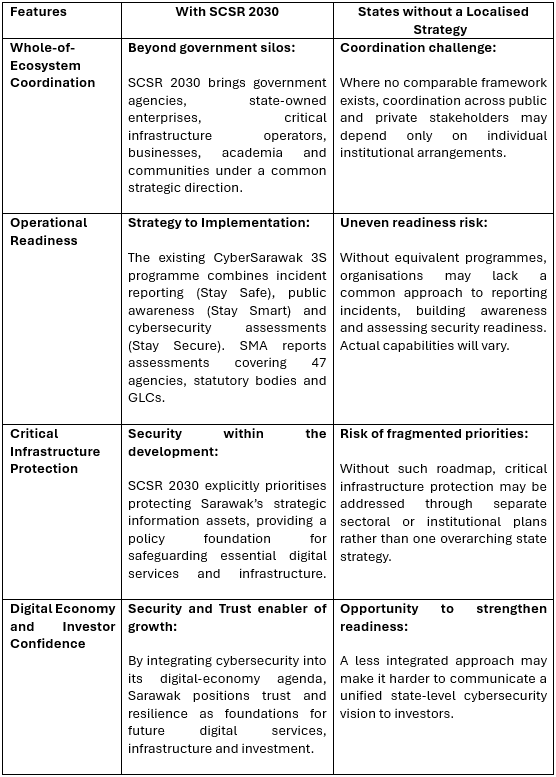
With an ambitious objective to digitalize 100% of its public services by 2030, Sarawak is not just implementing new software, it is building a digital shield. The framework unifies 18 strategic initiatives under 5 core pillars, designed to anchor its massive pushes into green energy, advanced semiconductors, and multi-megawatt data center hubs.
To appreciate the gravity of the SCSR 2030, we examine the features below in isolation:
Cost of Inaction: Real-World Cyber Threats
Cybersecurity vulnerabilities has proven that they bring direct, painful real-world costs, from the exposure of sensitive personal data to disruptions affecting critical infrastructure and substantial financial losses. Recent incidents across East and West Malaysia illustrate the costs from different dimensions of cyber-risk:
1. Swinburne University of Technology Sarawak — Ransomware and data theft
In August 2024,Swinburne University of Technology Sarawak was listed on the dark-web leak site of the RansomHub ransomware group, which claimed to have stolen 366 GB of data. The university subsequently confirmed that investigations had identified the theft of certain sensitive information, including passport scans, student completion letters and student applications, highlighting the risks cyberattacks pose to personal data and institutional trust.
2. Malaysia Airports Holdings Berhad — Cyberattack affecting KLIA systems
On 23 March 2025, a cyber incident affected certain computer systems at Kuala Lumpur International Airport (KLIA), operated by Malaysia Airports Holdings Berhad (MAHB). The incident prompted a full-scale investigation, with MAHB notifying the NACSA and the Civil Aviation Authority of Malaysia. The Prime Minister subsequently disclosed that hackers had demanded a USD10 million ransom, underscoring the potential stakes when cyber threats target critical transportation infrastructure.
3. Sarawak — Rising cybercrime and financial losses
Between 2024 and April 2026, Sarawak recorded 5,875 cybercrime cases involving approximately RM233.48 million in financial losses. Investment scams accounted for approximately RM132.9 million, representing around 57% of the total losses. Kuching recorded RM45.77 million in losses across 782 cases, followed by Miri with RM33.13 million across 766 cases and Sibu with RM20.40 million across 721 cases. These figures demonstrate that cybercrime is not merely a threat to institutions and infrastructure; it also inflicts substantial financial harm on individuals and communities.
4. Malaysia's ransomware threat landscape — Akira and Ransom Hub
A ransomware threat assessment published by Simply Data on 23 August 2026 identified Akira and RansomHub among the ransomware groups associated with attacks on Malaysian organisations during the first half of 2026. The report identified exposed remote-access infrastructure, including VPN appliances and Remote Desktop Protocol (RDP) endpoints, as attack vectors associated with Akira, and linked RansomHub to targets in Malaysia's financial sector. These findings reinforce the need for proactive security controls, effective threat detection and coordinated incident-response capabilities.
Taken together, these incidents illustrate the consequences of cybersecurity being an afterthought. The damage extends beyond technical disruption to personal data breaches, financial losses, threats to essential services and a loss of public trust. For businesses at the digital forefront, this presents another challenge. Innovation comes with a cost of compliance that must be factored into the business from the outset, rather than addressed only when regulatory requirements arise or an incident occurs.
In this context, the SCSR 2030 strategy prompts an important question: does introducing state-level oversight alongside existing federal regulations create an overregulated environment? Not necessarily. Instead, state-level initiatives should serve as a wake-up call for companies to view security as a core component of responsible innovation. The true test will be ensuring that state and federal frameworks align seamlessly, offering clear, balanced requirements rather than redundant paperwork that fails to improve actual protection.
We can see clearly how the SCSR 2030 has established a critical precedent. SCSR 2030 offers a framework for making cybersecurity an integral part of digital development, rather than an afterthought. The SCSR 2030 further ensures that as the state scales its digital ambitions, from localised AI hubs to smart utility grids, its sovereignty remains uncompromised. For the rest of the country, this precedent is an important one, the future lies in resilience, and it belongs to those who retain the power to protect, govern and control what they build.
This article was authored by Jonathan Lim, Managing Partner, and Laurel Lim, Senior Associate, with contributions from Nadarashnaraj Sargunaraj, Partner, and Mohamad Izahar Mohamad Izham, Partner.
This article is for general informational purposes only and does not constitute legal advice. Please contact us if you require advice on how these developments may affect your business.