
Resources
Welcome to our knowledge base of research that demonstrates our understanding of complex business challenges faced by companies around the world.
Featured highlights
Perbadanan Pengurusan Megan Avenue 1 v. Rajinder Singh Kuldip Singh [2026] 6 MLRH 435 (High Court Malaya, Kuala Lumpur, Moh Kok Wai JC, 18 June 2026)
Who pays when a strata unit is sold at a court-ordered auction, and the previous owner has left behind substantial unpaid maintenance charges and sinking fund contributions? The High Court in Kuala Lumpur has held that it is not the buyer, at least where the sale follows a chargee bank’s foreclosure.
The facts
Forward Wind Sdn Bhd, the registered owner of an office unit at Megan Avenue 1, fell badly into arrears with the management corporation (MC), which obtained a consent judgment against it for RM126,524.45 in November 2022. Separately, Forward Wind’s chargee, CIMB Bank, obtained an order for sale, and the defendant, who had no connection with Forward Wind, won the High Court e-auction on 4 January 2024 with a bid ofRM1,620,000. Forward Wind was ordered to be wound up on 13 March 2024, and the defendant was registered as proprietor on 19 August 2024. The MC then demanded RM182,309.41 from him in historical arrears, relying on ss 60(4) and 61(4) of the Strata Management Act 2013 (SMA), which allow charges to be recovered from “the proprietor of, or his successor-in-title to, the parcel”.
The decision
The court dismissed the claim. The SMA does not define “successor in title”. In ordinary property law, it describes someone who steps into the previous owner’s position and takes on the burdens that come with the property. The defendant did not do that. Title passed to him “by operation of law” when a registered charge was enforced, not through any voluntary transfer from Forward Wind.
The MC relied on the Court of Appeal’s decision in Brightvite Sdn Bhd v. Pantai Towers Management Corporation [2018] 4 MLRA 457, which treated the unpaid sum as a single debt recoverable from either the old proprietor or its successor. The judge accepted that Brightvite binds him but held that a precedent binds only within its material facts. Brightvite involved a private sale to buyers linked to the defaulting owner through common shareholding and directorship, who could have negotiated warranties, indemnities or a price adjustment. Here, the defendant was a “complete stranger” to Forward Wind, the sale took place under the court’s supervision, and with Forward Wind recorded as already in liquidation, any prospect of extracting contractual protection was “illusory”.
The court then turned to purpose. The SMA is social legislation, but it must be read purposively (following Mar Vista Resort [2025] 1 MLRA 402), and the mischief behind ss 60(4) and 61(4) is an owner escaping charges by transferring the unit voluntarily. That does not arise when a bank enforces its security. To hold otherwise would saddle auction buyers with hidden liabilities and undermine the “certainty, finality, and commercial reliability” that court-sanctioned sales are meant to provide. As the claim failed on construction, the court did not decide the defendant’s estoppel argument, which rested on what the MC’s accounts executive allegedly told his representative, though it noted the plea was advanced “with considerable force”.
Practical takeaways
- Auction buyers: The decision helps, but it is a first instance ruling. Still carry out the searches the proclamation of sale advises and consider asking for a certificate of outstanding charges under s 73 of the SMA.
- Private buyers: The decision does not assist you. Brightvite still governs voluntary transfers, so arrears can follow the unit. Insist on warranties, indemnities and clearance of charges before completion.
- MCs: Act early. Once the owner is in liquidation, you may be left as an unsecured creditor and the other proprietors may have to absorb the shortfall, a point the judge acknowledged as “a bitter pill”.
This is a High Court decision and may be appealed. Itis a general summary and does not constitute legal advice.
High Court Limits Strata Arrears Liability for Purchasers at Judicial Auctions
Legacy planning is often treated as something to think about later — when we're older, when the children are grown, when there's more wealth to distribute. But for Muslims, the obligation to plan is not a matter of convenience. It is a matter of faith, family, and financial responsibility.
Legacy planning is an act of worship
In Islam, preparing for what comes after death is not morbid — it is an act of ihsan (excellence in faith). The Prophet Muhammad (peace be upon him) encouraged Muslims to write their wills, stating that it is not befitting for a Muslim who has something to bequeath to let two nights pass without having a written will. Yet studies consistently show that a significant majority of Muslims pass away without any formal estate plan in place.
The consequences are real. Families are left navigating complex legal processes, assets are frozen, disputes arise among heirs, and the deceased's true intentions are never carried out.
Understanding faraid — and its limits
Many Muslims assume that faraid — the Quranic rules of inheritance — will take care of everything. Faraid is indeed a divine framework, and it provides a just and structured distribution of wealth among prescribed heirs. But faraid governs only the distribution of the estate. It does not address:
- How quickly assets can be accessed. Without proper documentation, estate administration can take years. Families may be left without access to funds they urgently need.
- Debts and liabilities. These must be settled before any distribution takes place. If the estate lacks liquidity, assets may need to be sold — sometimes at unfavourable prices.
- Non-faraid objectives. Faraid does not provide for non-Muslim family members, charitable causes, or specific bequests to individuals outside the prescribed heirs. It also does not preserve a family business or direct assets to a particular purpose.
- Guardianship of minor children. Faraid distributes wealth, but it does not appoint guardians or trustees to manage that wealth on behalf of young beneficiaries.
Legacy planning fills these gaps — not by overriding faraid, but by working within and alongside it.
The tools available to you
Shariah-compliant legacy planning offers a range of instruments that, when used together, create a comprehensive framework:
- Wasiyyah (Islamic will). You may allocate up to one-third of your net estate to non-heirs or charitable causes. This is your primary tool for discretionary giving — supporting a cause you believe in, providing for a non-Muslim relative, or funding an endowment.
- Hibah (lifetime gift). By transferring assets during your lifetime, you can direct wealth to specific individuals — including your faraid heirs — beyond what the mandatory shares provide. A properly executed hibah removes the asset from your faraid estate entirely.
- Waqf (Islamic endowment). For those who wish to create a lasting legacy, a waqf permanently dedicates assets to a charitable or family purpose. A family waqf can provide for your descendants for generations whilst eventually serving a broader social good.
- Takaful with hibah nomination. By declaring a hibah on your takaful policy, the benefit is paid directly to your named recipient upon your passing — without delay and without entering the faraid estate. This provides immediate liquidity when your family needs it most.
The cost of not planning
The absence of a legacy plan does not mean your estate will be distributed according to Shariah by default. In practice, it often means:
- Prolonged estate freezes. Bank accounts, properties, and investments are locked until the legal process is complete. In some jurisdictions, this can take years.
- Family disputes. Without clear documentation, disagreements over the deceased's intentions are common — and deeply damaging to family relationships.
- Loss of value. Forced asset sales to settle debts or divide the estate rarely achieve optimal prices.
- Unfulfilled intentions. Charitable wishes, provisions for specific family members, and business succession plans go unrecorded and unexecuted.
Planning is not about wealth — it is about responsibility
A common misconception is that legacy planning is only for the wealthy. In truth, anyone who owns a home, holds a takaful policy, has savings in a bank account, or has dependants who rely on them financially needs a plan. The smaller the estate, the more critical it is that every ringgit reaches the right hands at the right time.
Where to begin
Start with three steps:
- Take stock of your assets and liabilities. Know what you own, what you owe, and how your assets are held.
- Understand your faraid obligations. Identify who your prescribed heirs are and what their shares would be under current circumstances.
- Seek professional advice. A qualified Islamic estate planner can help you structure your wasiyyah, hibah, waqf, and takaful arrangements to work together as a cohesive plan — one that honours your faraid obligations, achieves your personal objectives, and protects your family.
Final thought
Legacy planning is not about predicting when we will leave this world. It is about ensuring that when we do, we leave behind clarity, provision, and peace of mind — for ourselves and for those we love. In Islam, this is not just prudent financial management. It is stewardship of the trust (amanah) that Allah has placed in our hands.
The information in this article is general in nature and does not constitute legal or financial advice. Readers are encouraged to consult qualified professionals for guidance tailored to their specific circumstances.
Why Every Muslim Needs a Legacy Plan — And Why Faraid Alone Is Not Enough
For decades, many Islamic financing facilities and sukuk in Malaysia have been priced using KLIBOR. While generally accepted from a Shariah perspective because it serves only as a reference benchmark and not as interest itself, KLIBOR is ultimately derived from activity in the conventional interbank market.
The introduction of MYOR-i (Malaysia Overnight Rate Islamic) represents a significant milestone in the continued maturation of Malaysia's Islamic finance ecosystem.
Some key distinctions:
✅ KLIBOR is a forward-looking term rate based on panel bank submissions and incorporate bank credit and liquidity premiums.
✅ MYOR-i is a transaction-based overnight rate derived from actual Islamic interbank market transactions, making it more closely linked to underlying Shariah-compliant market activity.
This development is about more than replacing one benchmark with another.
From a Shariah perspective, MYOR-i provides a reference rate rooted in Islamic market transactions rather than conventional lending activity.
From a benchmark integrity perspective, transaction-based rates are generally regarded as more transparent, robust and less susceptible to manipulation than submission-based benchmarks.
That said, the transition is not without challenges.
Unlike KLIBOR, which is known at the start of a profit period, MYOR-i is a backward-looking overnight rate that must be compounded or averaged over time. This creates important structuring, operational and documentation considerations, particularly for sale-based Islamic financing structures where certainty of price remains a fundamental Shariah requirement.
For financiers, issuers, legal advisers and Shariah committees, benchmark reform raises a range of issues, including:
- Benchmark transition provisions
- Fallback mechanisms
- Spread adjustments
- Operational readiness
- Product structuring considerations
- Shariah governance and approvals
Ultimately, the shift from KLIBOR to MYOR-i reflects a broader evolution in Islamic finance: moving towards benchmarks that are not only economically robust, but also more closely aligned with the activities of the Islamic financial market itself.
The real question may no longer be whether Islamic finance can use conventional benchmarks, but whether it now has a viable Islamic benchmark of its own.
This client alert is for general informational purposes only and does not constitute legal advice. Please contact us if you require advice on how these developments may affect your business.
KLIBOR vs MYOR-i: Why the Benchmark Matters in Islamic Finance
“A modern economy depends upon a modern law of contract. The world of 1950 did not contemplate artificial intelligence, smart contracts, algorithmic decision-making, cloud computing, digital marketplaces, platform economies, or the global interconnectedness of modern commerce. The law must evolve if it is to remain relevant and effective.” — Dato’ Seri Vazeer Alam bin Mydin Meera, Federal Court Judge and Chair of the Committee, The Edge Malaysia, 11 June 2026.
1. Background
The Committee for the Review and Reform of Contract Law (CRRCL) was established on 14 January 2025 and is chaired by Dato’ Seri Vazeer Alam bin Mydin Meera, Judge of the Federal Court. The initiative is led by the Legal Affairs Division of the Prime Minister’s Department (BHEUU) in collaboration with Monash University Malaysia and Universiti Kebangsaan Malaysia. The CRRCL’s eight working groups examined all 191 provisions of the Contracts Act 1950.
On 30 June 2026, the Minister in the Prime Minister’s Department (Law and Institutional Reform), Dato’ Sri Azalina Othman Said, briefed the Dewan Rakyat on the CRRCL’s Final Report. The reforms aim to enhance legal certainty, reduce transaction and dispute costs, strengthen investor confidence and align Malaysia’s commercial framework with ASEAN and international standards.
The CRRCL concluded that the core structure of the Contracts Act 1950 remains sound, and the Act will therefore not be repealed. Instead, the proposed reforms comprise three measures:
(a) targeted amendments to the Act, including modernising its language, removing statutory illustrations and introducing a new Part XI on exemption and limitation clauses;
(b) a new Contracts (Rights of Third Parties) Bill; and
(c) a new Agency Bill to repeal and replace Part X of the Act and the Powers ofAttorney Act 1949, addressing electronic transactions and artificial intelligence (AI) systems and establishing a unified powers-of-attorney regime.
2. Key Proposals
2.1 Modernising the Act
The CRRCL proposes to replace archaic expressions in the Contracts Act 1950 and remove statutory illustrations inherited from the Indian Contract Act 1872, incorporating any substantive legal principles into the Act’s operative provisions.
The amendments would standardise terminology. For example, “terminate” would consistently describe the discharge of a contract for breach, distinguishing it from avoidance on grounds affecting the validity of consent. Section 1 would also clarify that the Act is not a complete codification of contract law and that common law principles continue to apply where it is silent, reflecting the position recognised by the courts.
These changes should improve clarity and reduce disputes arising from statutory uncertainty. As they primarily concern the Act’s structure and expression, they are not expected, by themselves, to require changes to existing contracts.
2.2 Making and Varying Contracts
Contract formation and validity
The reforms would clarify the rules on how a contract is formed. Where the party making an offer specifies how it must be accepted (for example, in writing or by signing and returning a form), an acceptance made in any other way would not bind that party unless it expressly agrees to it. This gives businesses greater certainty as to when a binding contract comes into existence. In addition, where only part of an agreement is unlawful and that part can be clearly separated, only the unlawful part would be void and the rest of the agreement would remain enforceable.
Contracts entered into by minors would become voidable (that is, capable of being set aside by the minor) rather than void, while contracts for necessaries,contracts for the minor’s benefit (such as education, employment, training or internships) and contracts permitted by written law would be enforceable.
Protecting parties from improperly obtained consent
The reforms would replace “coercion” with “duress”, expressly including economic duress. A new statutory doctrine of unconscionable dealing would also be introduced. In deciding whether a dealing is unconscionable, courts could consider factors such as the parties’ relative bargaining strength, whether conditions were imposed that were not reasonably necessary to protect legitimate interests, and whether undue pressure or unfair tactics were used. Relief would be confined to serious misconduct, unfair advantage-taking or exploitation of a party’s special disadvantage, and would not be available merely because a bargain is harsh.
Consideration: deeds and contract variations
First, section 26 would expressly recognise that an agreement made by deed is enforceable without consideration, resolving long-standing uncertainty and aligning Malaysian law with jurisdictions such as the United Kingdom, Australia and Singapore.
Secondly, a new section 26A would provide that performing, or promising to perform, an existing contractual obligation is capable of being consideration for a variation. In practice, a party could validly agree to pay more, or accept less, in return for the other party performing what it was already bound to do. This would reverse the position reaffirmed by the Federal Court in Kuala Dimensi Sdn Bhd v Port Kelang Authority [2025] 5 MLJ 238 at [92], under which such a variation requires fresh consideration.
These changes would provide greater certainty when renegotiating price, scope of work and delivery timelines. Parties must still document variations properly and avoid duress or unconscionable dealing during negotiations.
2.3 Restrictive Covenants and Contractual Time Bars
Restrictive covenants: moving towards a reasonableness test
Section 28 of the Contracts Act 1950 renders void any agreement restraining a person from exercising a lawful profession, trade or business, subject only to narrow exceptions relating to the sale of goodwill and partnerships. Restraints outside these exceptions are void, even where they are reasonable.
The CRRCL proposes to replace this prohibition with a reasonableness test. A restraint would be enforceable if it is reasonable in duration, geographical area and scope of activities, and necessary to protect legitimate interests.The proposal also recognises categories such as the sale of goodwill, partnership dissolution, commercial agreements and non-competes during employment, and confirms that reasonable confidentiality clauses are notrestraints of trade.
This could enable employers, business purchasers and business partners to protect goodwill, client relationships and confidential know-how through appropriately drafted restrictive covenants. Businesses should review existing restrictions, as broad or excessive restraints would not automatically become enforceable.
Contractual time bars: greater certainty for commercial claims
Section 29 currently voids agreements that limit the time within which a party may enforce its contractual rights. The CRRCL proposes to remove this, so that an agreement would be void only to the extent that it absolutely prevents a party from enforcing its rights through the usual legal proceedings. In practice,reasonable contractual claims periods would generally be permissible.
The CRRCL declined to follow the more restrictive Indian approach, which it considered commercially impractical and potentially detrimental to Malaysia’s attractiveness as a jurisdiction for dispute resolution.
The changes could provide greater certainty for notification and claims periods in supply, construction and services agreements. Businesses should ensure theseprovisions are clearly drafted and consistent with the final legislation.
2.4 Controls on Exemption and Limitation Clauses
The CRRCL recommends stronger controls on exemption and limitation clauses througha new Part XI, modelled on the Unfair Contract Terms Act 1977 (UK).
First, parties could not exclude or restrict liability for death or personal injury caused by negligence, or liability for supplying goods without title. Secondly, exclusions or restrictions of other liabilities would be enforceable only if reasonable. These include liability for negligence causing other loss, misrepresentation, and breaches of statutory implied terms concerning the description, quality and fitness for purpose of goods.
Part XI is significant because it is not limited to consumer transactions. The Consumer Protection Act 1999 regulates unfair terms in consumer contracts but does not extend to business-to-business dealings. Under Part XI, where one business deals on the other’s written standard terms of business, the exclusion and limitation clauses in those terms would be enforceable only if reasonable.The party relying on the clause would bear the burden of proving that it isreasonable.
The proposed controls on negligence liability and standard terms of business would not extend to certain contracts, including insurance contracts and contracts relating to land, intellectual property, the formation or constitution of companies and securities, although the CRRCL noted that these exclusions require further consideration in the Malaysian context. Suppliers, service providers and technology vendors should review their exclusion clauses and liability caps for reasonableness. Business customers would gain a statutory basis to challenge unreasonable terms, particularly in standard-form contracts presented on a take-it-or-leave-it basis.
2.5 Two Proposed New Bills: Third-Party Rights and Agency
Contracts (Rights of Third Parties) Bill
Underthe doctrine of privity, a person who is not party to a contract generally cannot enforce its terms, even if the contract benefits them. The Contracts Act 1950 does not currently address third-party rights.
The proposed Bill would allow third parties to enforce terms intended to benefit them. Once a third party has assented to or relied on a term, it generally could not be varied or terminated without their consent, unless the contract provides otherwise. Third parties enforcing a term would also be bound by any arbitration agreement in the contract.
The Bill could simplify group and project arrangements by reducing the need forseparate agreements. Businesses should review whether to permit or expressly exclude third-party enforcement.
Agency Bill
The proposed Agency Bill would repeal and replace Part X of the Contracts Act 1950 and the Powers of Attorney Act 1949. It would confirm that a contract is not invalid merely because it was formed through electronic agents, including AI systems, and establish a unified powers-of-attorney regime across Peninsular Malaysia, Sabah and Sarawak. It would also simplify the rules on seals: an agent would no longer need to be appointed under seal to execute a sealed document, and could execute such a document under hand.
The Bill would provide greater certainty for automated and AI-enabled transactions. Businesses should strengthen system controls and ensure agreements with technology providers appropriately allocate responsibility and risk.
2.6 Remedies, Frustration and Security
Damages for breach of contract
Section 74 would clarify that recoverable loss includes loss arising naturally in the usual course of things and loss the parties knew or could reasonably have contemplated when contracting, aligning the provision with the common law rule on remoteness of damage in Hadley v Baxendale (1854) 9 Exch 341. The duty to mitigate loss would also be expressly incorporated into the Act.
Agreed damages and forfeiture of deposits
The proposed revision of section 75 would replace the distinction between penalties and liquidated damages with a single standard of reasonable compensation. A party claiming agreed damages would need to show that the sum is not exorbitant or disproportionate to the greatest legitimate loss, with any award capped at the contractual amount.
The claimant would need to provide some evidence to assist the court in assessing reasonableness, but would not need to prove actual loss in the same manner as aclaim for general damages.
Forfeiture of deposits would also be expressly permitted if reasonable. These changes could improve predictability in construction, property development and supply contracts. Businesses should document the commercial rationale and anticipated loss underlying agreed damages and ensure deposit and forfeiture provisions are justifiable.
Supervening impossibility and illegality
The CRRCL proposes to clarify section 57 so that, where a contract becomes void because of supervening impossibility or illegality, sections 15 and 16 of the Civil Law Act 1956 would govern the adjustment of payments and benefits between the parties. This makes the existing position explicit rather than introducing new rights.
The CRRCL considered, but did not adopt, proposals for statutory hardship and force majeure doctrines. Relief from unforeseen events would therefore continue to depend principally on existing legal principles and contractual terms. Businesses should review force majeure clauses to ensure they address relevant events, notice requirements and prolonged disruption.
Pledges and subsequent advances
A proposed amendment to section 127 would remove the presumption that a pledge extends to subsequent advances, requiring any extension to be expressly agreed. Financial institutions and other secured creditors should ensure their security documents clearly address subsequent advances.
3. Conclusion: Preparing for the Reform
The CRRCL’s Final Report is the first comprehensive review of the Contracts Act 1950 since its enactment. The reforms seek to modernise the Act, codify principles developed by the courts and address long-standing gaps while retaining its core structure.
For businesses, the proposals could improve certainty in contractual variations, restrictive covenants, agreed damages and digital transactions. However, new controls on exemption and limitation clauses and third-party contractual rights may require changes to how contracts allocate risk and define enforceable rights.
Although the proposals remain subject to the legislative process, businesses should begin reviewing their standard terms, template agreements and contracting practices, particularly liability provisions, agreed damages, restrictive covenants, force majeure clauses and third-party rights.
Zaid Ibrahim & Co will organise client briefings and prepare practical playbooks to help clients navigate thereforms once the legislative amendments have been finalised and published.
Contracts Act 1950 Reform: A Strong Report and a Much-Needed Step towards Modernisation
Introduction
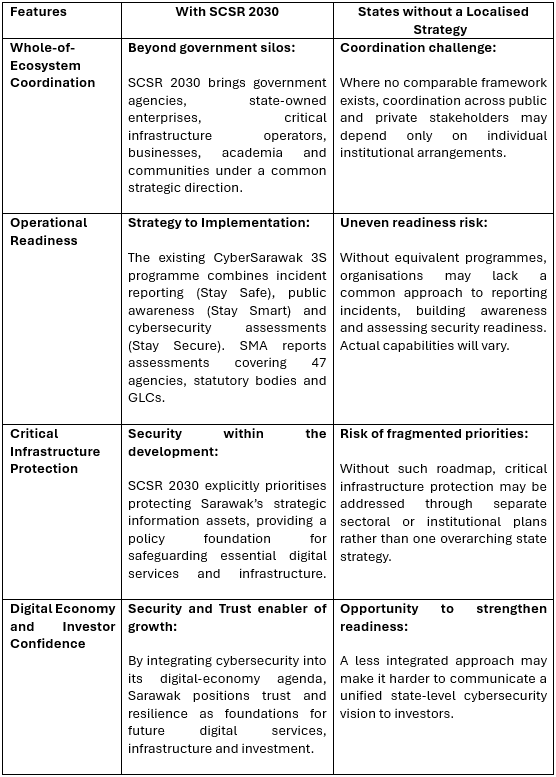
As data rapidly transforms from an organizational asset into state sovereignty, regional governments are pivoting away from outsourcing their safety to distant, centralized frameworks. Sarawak made a decisive move in late 2026 by launching the Sarawak Cybersecurity Strategy and Roadmap (SCSR) 2030, a comprehensive state-level cybersecurity framework, catering for this very objective. Driven directly by the Sarawak Multimedia Authority (SMA), this 5-year roadmap positions Sarawak as the first state in Malaysia to pioneer its own comprehensive, localized defense infrastructure.
With an ambitious objective to digitalize 100% of its public services by 2030, Sarawak is not just implementing new software, it is building a digital shield. The framework unifies 18 strategic initiatives under 5 core pillars, designed to anchor its massive pushes into green energy, advanced semiconductors, and multi-megawatt data center hubs.
To appreciate the gravity of the SCSR 2030, we examine the features below in isolation:
Cost of Inaction: Real-World Cyber Threats
Cybersecurity vulnerabilities has proven that they bring direct, painful real-world costs, from the exposure of sensitive personal data to disruptions affecting critical infrastructure and substantial financial losses. Recent incidents across East and West Malaysia illustrate the costs from different dimensions of cyber-risk:
1. Swinburne University of Technology Sarawak — Ransomware and data theft
In August 2024,Swinburne University of Technology Sarawak was listed on the dark-web leak site of the RansomHub ransomware group, which claimed to have stolen 366 GB of data. The university subsequently confirmed that investigations had identified the theft of certain sensitive information, including passport scans, student completion letters and student applications, highlighting the risks cyberattacks pose to personal data and institutional trust.
2. Malaysia Airports Holdings Berhad — Cyberattack affecting KLIA systems
On 23 March 2025, a cyber incident affected certain computer systems at Kuala Lumpur International Airport (KLIA), operated by Malaysia Airports Holdings Berhad (MAHB). The incident prompted a full-scale investigation, with MAHB notifying the NACSA and the Civil Aviation Authority of Malaysia. The Prime Minister subsequently disclosed that hackers had demanded a USD10 million ransom, underscoring the potential stakes when cyber threats target critical transportation infrastructure.
3. Sarawak — Rising cybercrime and financial losses
Between 2024 and April 2026, Sarawak recorded 5,875 cybercrime cases involving approximately RM233.48 million in financial losses. Investment scams accounted for approximately RM132.9 million, representing around 57% of the total losses. Kuching recorded RM45.77 million in losses across 782 cases, followed by Miri with RM33.13 million across 766 cases and Sibu with RM20.40 million across 721 cases. These figures demonstrate that cybercrime is not merely a threat to institutions and infrastructure; it also inflicts substantial financial harm on individuals and communities.
4. Malaysia's ransomware threat landscape — Akira and Ransom Hub
A ransomware threat assessment published by Simply Data on 23 August 2026 identified Akira and RansomHub among the ransomware groups associated with attacks on Malaysian organisations during the first half of 2026. The report identified exposed remote-access infrastructure, including VPN appliances and Remote Desktop Protocol (RDP) endpoints, as attack vectors associated with Akira, and linked RansomHub to targets in Malaysia's financial sector. These findings reinforce the need for proactive security controls, effective threat detection and coordinated incident-response capabilities.
Taken together, these incidents illustrate the consequences of cybersecurity being an afterthought. The damage extends beyond technical disruption to personal data breaches, financial losses, threats to essential services and a loss of public trust. For businesses at the digital forefront, this presents another challenge. Innovation comes with a cost of compliance that must be factored into the business from the outset, rather than addressed only when regulatory requirements arise or an incident occurs.
In this context, the SCSR 2030 strategy prompts an important question: does introducing state-level oversight alongside existing federal regulations create an overregulated environment? Not necessarily. Instead, state-level initiatives should serve as a wake-up call for companies to view security as a core component of responsible innovation. The true test will be ensuring that state and federal frameworks align seamlessly, offering clear, balanced requirements rather than redundant paperwork that fails to improve actual protection.
We can see clearly how the SCSR 2030 has established a critical precedent. SCSR 2030 offers a framework for making cybersecurity an integral part of digital development, rather than an afterthought. The SCSR 2030 further ensures that as the state scales its digital ambitions, from localised AI hubs to smart utility grids, its sovereignty remains uncompromised. For the rest of the country, this precedent is an important one, the future lies in resilience, and it belongs to those who retain the power to protect, govern and control what they build.
This article was authored by Jonathan Lim, Managing Partner, and Laurel Lim, Senior Associate, with contributions from Nadarashnaraj Sargunaraj, Partner, and Mohamad Izahar Mohamad Izham, Partner.
This article is for general informational purposes only and does not constitute legal advice. Please contact us if you require advice on how these developments may affect your business.
The Digital Shield: Sarawak’s Building Blocks for a Fortress for its Digital Economy
One of the original promises of digital assets was simple: value moving across borders with minimal friction and full transparency. Today, Malaysia is taking steps towards that vision, developing regulated digital asset infrastructure intended to support domestic financial innovation and potentially enhance regional market integration.
Through Bank Negara Malaysia’s (BNM) Digital Asset Innovation Hub (DAIH), launched in June 2025, Malaysia has established a dedicated environment to test real-world applications. The DAIH currently emphasises testing tokenised bank deposits, while BNM’s broader strategic horizon continues to explore tokenised sukuk, stablecoins and automated supply chain finance. If this roadmap is anchored in institutional liquidity and cross-border commercial trade, Malaysia has the potential to reduce structural friction and unlock real economic value within a live banking ecosystem. The Securities Commission Malaysia (SC) is also relevant to the digital asset and tokenised capital markets framework, including tokenised sukuk. The boundary between the BNM and SC perimeters is itself an interoperability question: participants need clarity on which regulator governs each asset, activity and point in the transaction chain.
Across Asia, neighbouring jurisdictions are advancing their own tailored regulatory regimes. Singapore, for instance, has been moving beyond initial proofs of concept under Project Guardian and developing commercial digital infrastructure through Global Layer One (GL1) and settlement networks such as BLOOM, while its framework for digital payment tokens (DPTs) under the statutory Payment Services Act (PSA) and its regulatory framework for single-currency stablecoins continue to evolve. Hong Kong’s stablecoin licensing regime, which came into effect in August 2025, offers a useful comparator for how reserve-backed digital money may be supervised. Meanwhile, Taiwan has enacted a statutory framework specifically for virtual asset service providers (VASPs), although its Virtual Asset Service Act has not yet entered into force.
Individually, these domestic frameworks represent major regulatory milestones. But what happens between them when a transaction crosses a border?
Consider a scenario where a ringgit stablecoin or tokenised deposit issued under BNM’s DAIH framework interacts with an institution operating under Singapore’s PSA regime, or where a tokenised asset residing in Malaysia is settled using digital fiat originating from a foreign market. While ledger transfers execute in seconds, the underlying legal, regulatory, and institutional mechanics remain firmly bound to national borders. Critical friction points immediately surface:
- Regulatory Perimeter & Licensing: Which jurisdiction holds primary licensing authority when digital asset services, custody nodes, and smart contract execution layers span multiple borders?
- Monetary & Sanctions Reconciliation: How are foreign exchange controls, capital flow management measures, and disparate AML/CFT or sanctions screening standards reconciled between distinct payment regimes?
- Private Law & Insolvency Finality: In cross-border collateral transfers or tokenised asset defaults, which country's legal system determines property rights, choice-of-law priority and custody ring-fencing during an insolvency event? For example, if a tokenised asset held for a Malaysian investor is custodied in Singapore and the Singapore custodian becomes insolvent, does Malaysian law, Singapore law or the governing law of the tokenised asset determine whether the asset is ring-fenced from the custodian’s creditors? The answer may depend on the asset, the custody structure and the applicable conflict-of-laws rules.
Beyond Sandboxes: Building Interoperable Architecture
Sandboxes like BNM’s DAIH are essential for evaluating technical viability and informing national policy. However, a sandbox or regulatory perimeter in one market cannot, by itself, determine how a Malaysian digital asset structure legally interacts with counterparties in Singapore, Hong Kong, or beyond. That requires an overlay of legal and regulatory interoperability operating across borders.
Multilateral central bank initiatives, such as Project Mandala, led by the BIS Innovation Hub with participating central banks including BNM, MAS, Reserve Bank of Australia, Banque de France, Reserve Bank of India, Central Bank of Kuwait, Bangko Sentral ng Pilipinas takes a major step forward by exploring how regulatory parameters can be embedded directly into transaction protocols. Yet, protocol-level "compliance-by-design" is only one layer of the solution.
The surrounding legal architecture, from institutional custody agreements and master clearing documentation to the cross-border enforce ability of smart contracts must be equally interconnected. For institutional market participants, cross-border interoperability is no longer a theoretical debate. Regulatory posture is increasingly transitioning from a domestic compliance checkbox to a core pillar of regional commercial strategy.
Bridging the Gap: What Interoperability Requires
Technical interoperability is necessary but insufficient. Cross-border digital asset markets also require a legal and regulatory framework that can travel with the transaction.
- Mutual recognition or passporting between regulators, supported by clear limits and supervisory cooperation;
- Harmonised conflict-of-laws approaches, drawing where appropriate on the UNIDROIT Principles on Digital Assets and Private Law;
- Alignment of the FATF Travel Rule across corridors to support consistent AML/CFT controls;
- Standardised cross-border documentation, including master agreements and custody terms;
- ASEAN-level coordination to reduce fragmentation while preserving appropriate national safeguards.
The answer to the question posed above is yes—but only if legal interoperability is built alongside technical interoperability.
What This Means for Market Participants
For market participants, the practical agenda is immediate:
- Map the licensing touchpoints of each cross-border flow, including issuance, custody, settlement and technology services;
- Stress-test governing-law and insolvency provisions in tokenisation documentation, including the treatment of assets held through an overseas custodian;
- Align AML and sanctions screening across relevant corridors, with clear responsibility for Travel Rule information;
- Engage early with DAIH and relevant regional initiatives to test legal, regulatory and technical assumptions before scaling.
The Road Ahead
The next phase of digital assets in Asia will not merely be about perfecting domestic frameworks within individual borders; it will be about making those frameworks work together in practice. Market participants should treat legal interoperability as a design requirement: identify licensing perimeters, document governing-law and insolvency outcomes, and align AML/CFT controls before a transaction crosses a border.
Malaysia’s DAIH and regional initiatives could provide practical forums to test that approach. The jurisdictions that connect regulatory, legal and technical layers will be best placed to turn tokenisation into durable cross-border infrastructure.
This article is written by Managing Partner, Jonathan Lim and Senior Associate, Laurel Lim.
This article is for general informational purposes only and does not constitute legal advice. Please contact us if you require advice on how these developments may affect your business.
Asia Can Regulate Digital Assets, But Can It Connect Them?
1. Introduction
One of the most common misconceptions in capital markets is that a ṣukūk is simply the Islamic equivalent of a conventional bond. Both instruments can achieve a similar funding outcome for issuers, and both provide investment returns to investors. Yet this surface-level resemblance conceals a fundamental divergence in their legal and structural foundations. A conventional bond is generally a debt obligation: the investor lends money to the issuer and, in return, receives periodic interest payments and the repayment of principal over the life of the instrument. A ṣukūk, by contrast, is typically structured around ownership or beneficial interests in assets, usufructs, investments, or business ventures. Rather than representing a pure debt claim, ṣukūk structures are designed to comply with Sharīʻah principles by linking investors to an underlying asset or economic activity.
This distinction is not merely theoretical. It carries profound implications for how ṣukūk ought to be classified, regulated, taxed, and treated in the capital adequacy frameworks of financial institutions. If a ṣukūk genuinely embeds risk-sharing, links returns to the performance of real assets, and avoids guaranteeing the return of capital, then it may more accurately be characterised as an equity investment rather than a debt obligation.
Can ṣukūk be properly treated as equity investments? Drawing on the AAOIFI’s evolving standards, the proposed exposure draft SS ED 62, the International Accounting Standard 32 (“IAS 32”) classification framework, and recent proposals for mushārakah-based infrastructure ṣukūk in Malaysia, it does appear that certain ṣukūk structures—particularly those built on muḍārabah and mushārakah contracts—can and should be recognised as equity or quasi-equity instruments. The barriers to this recognition are institutional and behavioural, not technical or Sharīʻah-based.
2. The Debt–Equity Spectrum: Where Do Ṣukūk Sit?
Conventional financial taxonomy operates along a binary axis: instruments are either debt or equity. Bonds, loans, and notes sit firmly on the debt side; ordinary shares and partnership interests sit on the equity side. Ṣukūk, however, do not fit neatly into either category. They are, by design, hybrid instruments whose characteristics straddle the debt–equity divide.
A muḍārabah ṣukūk, for example, involves one party providing capital and another providing entrepreneurial expertise. The investor’s return is a share of the profits generated by the venture, not a fixed coupon. If the venture generates no profit, the investor earns nothing. If the venture incurs losses, the investor bears those losses to the extent of the capital contributed. This structure carries unmistakable equity-like features: residual, participatory claims on performance rather than a fixed, unconditional right to repayment.
A mushārakah ṣukūk takes this further. Here, multiple parties contribute capital to a joint venture and share both profits and losses in agreed proportions. The certificate holders become co-owners of the underlying venture or assets. Their returns are linked directly to the venture’s performance, and their exposure extends beyond the creditworthiness of any single originator.
Yet both muḍārabah and mushārakah ṣukūk also carry features associated with debt instruments. They typically have a defined maturity date, a terminal redemption mechanism, and—in practice—structures that provide investors with a degree of capital protection through purchase undertakings or liquidity facilities. The hybrid character of these instruments, combining features of both debt and equity, makes them susceptible to the agency problems associated with both financing forms simultaneously.
Some scholars have suggested that this taxonomic ambiguity could be resolved by adopting an alternative designation. The term “Islamic Investment Certificates” (IICs) has been proposed to signal that the instruments are fundamentally equity-like and risk-sharing in nature, rather than fixed-income obligations dressed in Islamic nomenclature.
It is important to note the regulatory context. Under Malaysian law, a ṣukūk is generally included within the statutory definition of a “debenture.” This means that, for certain legal and regulatory purposes, ṣukūk and conventional debt securities may be treated similarly. However, as the Securities Commission Malaysia has itself acknowledged, this regulatory treatment does not make a ṣukūk a conventional bond. The inclusion is a matter of administrative convenience and investor protection, not a determination of economic substance.
3. The Case for Equity Treatment
The strongest case for treating ṣukūk as equity investments arises from structures built on mushārakah (joint venture) contracts, particularly where the ṣukūk are deployed in infrastructure projects.
Academic proposals for Mushārakah-based sovereign sukuk structures suggest that equity characteristics can be embedded through the instrument's risk-sharing architecture and governance design, rather than through nomenclature alone.
3.1 Genuine Co-ownership, Not a Debt Claim
The proposed mushārakah structure establishes genuine co-ownership in infrastructure assets rather than a debt claim against the originator. Certificate holders acquire undivided proportional ownership interests in the underlying project assets—toll roads, power plants, water treatment facilities—and their returns flow from the economic performance of those assets. This is fundamentally different from a conventional bond, where the investor's claim is against the issuer's general creditworthiness.
The AAOIFI's proposed exposure draft, SS ED 62, reinforces this distinction. Clause 2/1 defines ṣukūk as:
Equal-value investment securities representing undivided common ownership interests in underlying assets, whether tangible assets, usufructs, rights, debts, cash, or any combination thereof, that give rise to rights and obligations for certificate holders arising from their proportional ownership share.
This definition places ownership—not lending—at the centre of the ṣukūk relationship.
3.2 Five Distinguishing Characteristics
SS ED 62 Clause 3 enumerates five characteristics that distinguish ṣukūk from conventional bonds:
- Not based on interest-bearing lending (Clause 3/1). Ṣukūk returns derive from asset ownership or venture participation, not from the time value of money lent.
- Principal and profit are not automatically obligations of the originator (Clause 3/2).Unlike a bondholder, a ṣukūk certificate holder does not have an unconditional right to demand repayment of capital or a guaranteed return.
- Certificate holders share both the rewards (ghunm) and the burdens (ghurm) (Clause 3/3).The Sharīʻah maxim of al-ghunm bi al-ghurm mandates that entitlement to profit must be accompanied by exposure to loss.
- Issued pursuant to Sharīʻah contracts (Clause 3/4). The governing contracts determine the nature and extent of the certificate holder’s rights, which may differ materially from conventional fixed-income instruments.
- Risks are not confined to the originator's credit risk (Clause 3/5). Certificate holders are exposed to the performance risk of the underlying assets or venture, not merely to whether the originator can service its debts.
3.3 Elimination of Fixed Financial Obligations
A defining feature of the proposed mushārakah structure is the elimination of fixed financial obligations. There are no fixed profit payments. There is no guaranteed return of principal. Returns are linked entirely to the actual performance of the underlying infrastructure project.
SS ED 62 Clause 11/2/3 prohibits separating the profits of the ṣukūk from the returns of its underlying assets, reinforcing the requirement that ṣukūk returns must be genuine and performance-linked rather than predetermined.
The structure further provides that any purchase undertaking must be at fair market value determined at the time of the transaction, and must not be mandatory. This avoids the capital guarantee mechanisms that have historically rendered many ṣukūk debt-like in substance. The government's in-kind contribution—land, concession rights, or existing infrastructure—constitutes a capital contribution to the mushārakah venture rather than collateral securing a debt obligation.
3.4 Quasi-Equity Recognition
The AAOIFI has recognised the quasi-equity nature of these instruments in its accounting standards. Both muḍārabah and mushārakah ṣukūk should be understood as quasi-equity instruments: their returns are linked to the performance of real underlying assets rather than to a contractual obligation to pay a fixed amount. They do not fall within the category of fixed-income securities.
AAOIFI has introduced a quasi-equity classification in financial reporting, acknowledging that these instruments integrate characteristics of both debt and equity. This classification is significant because it provides a formal accounting framework that recognises the hybrid nature of risk-sharing ṣukūk without forcing them into the binary debt-or-equity taxonomy of conventional finance.
4. The IAS 32 and Accounting Perspective
The accounting classification of a financial instrument as equity or liability is governed by IAS 32, Financial Instruments: Presentation. Critically, IAS 32 requires classification based on the economic substance of the contractual arrangement, not its legal form. The label attached to an instrument—whether “ṣukūk,” “bond,” “note,” or “certificate”—is irrelevant to its accounting treatment. What matters is the nature of the rights and obligations created by the contract.
The key test under IAS 32 is whether the issuer has a contractual obligation to deliver cash or another financial asset to the holder. If such an obligation exists, the instrument is classified as a financial liability. If it does not, the instrument may be classified as equity.
In the context of the proposed mushārakah-based ṣukūk, three features are determinative:
- No fixed repayment obligation. The government does not contractually undertake to return the investors' capital at a fixed amount. Redemption, if it occurs, is at fair market value.
- No fixed return obligation. Returns to certificate holders are a share of the project's actual performance, not a predetermined coupon.
- Non-binding purchase undertaking. Provided the purchase undertaking is drafted as a non-binding option rather than a binding obligation, the issuer is not contractually compelled to repurchase the ṣukūk at maturity.
If these conditions hold, the instrument may be classified as equity or as a hybrid instrument without a liability component under IAS 32. The IFRS classification decision tree confirms this analysis: where there is no contractual obligation to deliver cash, the instrument falls on the equity side of the classification.
The government's in-kind contribution—land, concession rights, or existing infrastructure asets—should be recognised as an equity investment inthe mushārakah venture rather than as a debt obligation. This treatment reflects the economic reality of the arrangement: the government is contributing capital to a joint enterprise, not borrowing money that must be repaid.
Classification as equity rather than debt directly affects the government's balance sheet, its debt-to-GDP ratios, its fiscal headroom, and the capital adequacy treatment of institutions holding the ṣukūk. If the instrument is properly classified as equity, it does not increase the sovereign debt burden—a significant advantage for governments seeking to finance infrastructure without expanding their liabilities.
5. Regulatory and Capital Adequacy Challenges
Despite the strong Sharīʻah and accounting arguments for equity treatment, regulatory frameworks remain stubbornly debt-centric. In Malaysia, once an instrument is labelled a “ṣukūk,” it is often automatically treated as debt or fixed income, regardless of the nature of the underlying contract. This regulatory presumption creates a self-reinforcing cycle: issuers structure ṣukūk to behave like debt because regulators classify them as debt, and regulators classify them as debt because issuers structure them to behave that way.
Capital adequacy requirements compound the problem. Under the standards issued by the Islamic Financial Services Board (IFSB), capital requirements of 300 to 400 per cent are imposed on mushārakah exposures under certain approaches. These charges are disproportionately high relative to the actual risk profile of well-structured, revenue-generating infrastructure partnerships. The result is that financial institutions face a punitive capital cost for holding risk-sharing ṣukūk, which in turn depresses demand and discourages issuance.
Bank Negara Malaysia (BNM) assigns a credit risk weight of approximately 150 per cent to certain mushārakah and muḍārabah exposures. However, BNM’s Capital Adequacy Framework for Islamic Banks (CAFIB) also provides for a supervisory slotting approach, under which the risk weight is determined by the quality of the underlying exposure rather than its contractual label. A well-structured, revenue-generating sovereign infrastructure partnership could credibly attain a “strong” or “good” slotting classification, attracting a risk weight of 70 to 90 per cent—significantly lower than the standard mushārakah charge.
Importantly, BNM’s CAFIB requires the regulatory capital treatment of any ṣukūk to follow its economic substance and actual risk profile rather than its legal form. This is a critical principle. It means that, in theory, a mushārakah ṣukūk structured with genuine risk-sharing and backed by revenue-generating infrastructure assets need not attract the punitive capital charges that deter banks from holding such instruments.
The regulatory challenge, then, is not one of principle but of practice. The principle of substance over form is well-established in both accounting and prudential regulation. The difficulty lies in translating that principle into consistent regulatory practice, particularly when the default taxonomy treats all ṣukūk as debt. As the IERIF report observes, regulatory classification as “debt” is a matter of regulatory taxonomy rather than economic substance. From both Sharīʻah and accounting perspectives, what is determinative is the underlying structure and allocation of risk, not the terminology applied by regulators.
6. Market Resistance and Behavioural Barriers
Even where the legal, Sharīʻah, and accounting arguments for equity treatment are compelling, market practice has consistently resisted the shift. The barriers are deeply embedded in the institutional culture of Islamic capital markets.
The entrenched mindset that equates ṣukūk with debt is perhaps the most formidable obstacle. For decades, market participants—issuers, arrangers, investors, rating agencies, and regulators—have operated on the assumption that ṣukūk are the Islamic equivalent of bonds. Pricing conventions reflect this: ṣukūk are typically priced off a benchmark yield curve, with a fixed or floating "profit rate" that mirrors a conventional coupon. Purchase undertakings at fixed redemption amounts are commonplace, providing investors with effective capital protection that renders the instruments debt-like in economic substance, whatever their Sharīʻah characterisation.
Investor preferences have been shaped by decades of experience with capital-guaranteed products. Institutional investors—pension funds, insurance companies, sovereign wealth funds—are mandated or accustomed to investing in instruments that provide predictable cash flows and capital preservation. A genuinely risk-sharing ṣukūk, where returns fluctuate with project performance and capital is at risk, does not fit comfortably within these investment parameters.
Historical episodes have reinforced these behavioural patterns.
A frequently cited example is the pre-2008 generation of Mushārakah sukuk, many of which incorporated purchase undertakings requiring the originator or managing partner to repurchase the sukuk assets at face value upon maturity or dissolution. Although labelled as Mushārakah and therefore ostensibly equity-based, the fixed-price repurchase mechanism effectively guaranteed investors' capital and substantially reduced their exposure to partnership losses, leading scholars and the AAOIFI Shari'ah Board to criticise such structures as debt-like in economic substance
A notable example is the US$1 billion 2007 sukuk issued by Dana Gas PJSC, which utilised a Mudarabah structure accompanied by a purchase undertaking requiring the obligor to acquire the sukuk holders' interest upon dissolution for a predetermined exercise price. Although the instrument was structured as a profit-sharing investment, the purchase undertaking substantially mitigated investors' exposure to capital loss and rendered the transaction economically closer to a debt instrument than a true risk-sharing venture. The structure exemplifies how the legal and economic substance of a sukuk may diverge from its formal characterisation as an equity-based instrument. The Dana Gas ṣukūk required a Sharīʻah ruling acknowledging non-compliance after payment difficulties emerged, highlighting the tension between stated Sharīʻah structures and actual market practice.
These examples illustrate a persistent pattern: ecosystem pressures consistently push issuers, arrangers, and rating agencies towards fixed-income conventions even where contracts are nominally structured as profit-sharing. The result is a market in which the form of Islamic finance is maintained—mushārakah contracts are used, assets are identified, Sharīʻah boards provide approvals—but the substance remains indistinguishable from conventional debt.
Rating agencies contribute to this dynamic. Their methodologies are calibrated for fixed-income instruments, assessing the issuer's ability to make scheduled payments and repay principal. A genuinely equity-like ṣukūk, where the certificate holder’s return depends on project performance rather than the issuer's credit strength, does not map well onto existing rating frameworks. Without a credit rating, many institutional investors cannot or will not invest, regardless of the instrument's underlying quality.
7. The Path Forward
If ṣukūk are to fulfil their potential as genuine equity or quasi-equity instruments—and if the Islamic capital markets are to move beyond the replication of conventional debt—a coordinated programme of policy and market reform is required. This could include:
- A formal national framework recognising risk-sharing ṣukūk as non-debt financing. An explicit regulatory classification that distinguishes risk-sharing ṣukūk (built on mushārakah and muḍārabah) from asset-backed or debt-replicating structures could be introduced. This framework could recognise that instruments with genuine risk-sharing, no capital guarantees, and performance-linked returns are equity or quasi-equity instruments, not debt obligations.
- Pilot implementation with brownfield infrastructure projects. Initial deployment should prioritise brownfield and upgrade-type projects—existing toll roads, power plants, or utilities with established revenue histories. These projects offer observable cash flow track records, reducing the information asymmetry that deters equity investors and enabling more confident valuation.
- Recalibration of capital adequacy charges. Regulators should ensure that the supervisory slotting approach is applied consistently to well-structured mushārakah ṣukūk, so that capital charges reflect the actual risk profile of the instrument rather than the punitive default weights for equity exposures. A sovereign infrastructure mushārakah with stable revenue streams should not attract the same capital charge as a speculative equity position.
- Tax neutrality between debt and risk-sharing instruments. Tax asymmetries that favour debt—such as the deductibility of interest payments but not profit-sharing distributions—must be corrected. Without tax neutrality, issuers will continue to prefer debt-like structures for purely fiscal reasons, regardless of Sharīʻah considerations.
- Introduction of an "Islamic Investment Certificates" classification. The adoption of a new classification, such as Islamic Investment Certificates, would signal to the market that these instruments are fundamentally different from conventional bonds. Nomenclature matters: as long as ṣukūk are labelled and categorised alongside bonds, the market will treat them as bonds.
- Phased implementation roadmap. Reform should proceed incrementally. A pilot programme with a limited number of well-structured issuances, supported by regulatory guidance and investor education, would build the evidence base and market confidence needed for broader adoption.
These reforms are not utopian. Each builds on principles already embedded in law, AAOIFI standards, and international accounting frameworks. What is required is the institutional will to apply those principles consistently and to resist the gravitational pull of debt-centric conventions.
8. Conclusion
A ṣukūk built on a mushārakah or muḍārabah contract, with genuine risk-sharing between issuer and investors, no capital or return guarantees, returns linked to the performance of real underlying assets, and natural exit mechanisms at fair market value, possesses the essential characteristics of an equity or quasi-equity instrument. The AAOIFI's proposed SS ED 62 standards confirm this. The IAS 32 classification framework supports it. The Sharīʻah principles of al-ghunm bi al-ghurm (reward accompanies risk) and the prohibition of ribā demand it.
The barriers to equity treatment are not technical. The legal structures exist. The accounting frameworks accommodate them. The Sharīʻah scholarship supports them. The barriers are institutional and behavioural: entrenched market conventions, debt-centric regulatory taxonomies, misaligned capital charges, tax asymmetries, and investor preferences shaped by decades of capital-guaranteed products.
Malaysia, as the world's largest ṣukūk market and a leader in Islamic finance innovation, is well-positioned to lead this transition. By introducing a formal framework for risk-sharing ṣukūk classification, piloting mushārakah-based structures in brownfield infrastructure projects, recalibrating capital adequacy requirements, and restoring tax neutrality, Malaysia can demonstrate that ṣukūk are not merely bonds with an Arabic name—they are a distinct class of investment instrument, capable of delivering the risk-sharing, asset-backed, real-economy financing that Islamic finance has always promised.
The shift from debt replication to genuine equity participation will not happen overnight. But every regulatory reform, every successful issuance, and every investor who accepts performance-linked returns over guaranteed coupons moves the market closer to what ṣukūk were always intended to be: instruments of shared enterprise, shared risk, and shared reward.
This article is for general informational purposes only and does not constitute legal advice. Please contact us if you require advice on how these developments may affect your business.
Can Sukuk Be Treated As An Equity Investment Rather Than A Debt Obligation?
This is a significant Court of Appeal decision — SA Puncak Management Sdn Bhd v KL Petrogas Sdn Bhd (25 August 2026) — that raises several important and, in some respects, provocative points for Islamic finance in Malaysia. Below is my analysis of the key issues from an Islamic finance perspective.
The Core Holding on the Moneylenders Act
The Court of Appeal reversed the High Court on all four questions, holding that the Islamic Pre-Factoring Facility did not breach s 5(1) of the Moneylenders Act 1951 (MA). The Court drew a critical distinction: s 5(1) MA prohibits the business of moneylending, not a mere activity of moneylending, and criticised the High Court for conflating the two. This was grounded in Federal Court authority from Ngui Mui Khin v Gillespie Bros and Yeep Mooi v Chu Chin Chua, both of which held that the MA targets moneylenders as a class of business, not isolated lending transactions.
The Court further held that whole turnover agreements (receivables purchase agreements) are a recognised form of debt financing, not moneylending, relying on the New Zealand authority of Commercial Factors Ltd v Maxwell Printing Ltd. It also held that even if the MA were engaged, SAPM was exempt under the Exemption Order (P.U.(B) 219/2005), a point the High Court had erroneously restricted to "legitimate factoring" only.
The Treatment of Shariah Non-Compliance — A Critical Point
The most consequential aspect of this judgment for Islamic finance practitioners is the Court of Appeal's treatment of the Shariah compliance question in Section F of the judgment. The Court declined to consider KLP's allegation of exorbitant profit and potential breach of Shariah principles for three reasons:
- Pleading deficiency — KLP's Amended Statement of Claim did not plead that the Islamic Pre-Factoring Facility had breached Shariah principles.
- Scope of the questions — The four questions before the Court did not concern the exorbitant profit allegation, much less a breach of Shariah principles.
- Substantive position — Even if there were a breach of Shariah principles, such a breach in itself does not invalidate the Islamic Pre-Factoring Facility.
On the third point, the Court relied heavily on the Court of Appeal's earlier decisions in Tan Sri Halim bin Saad v Amanah International Finance Bhd [2026] 2MLJ 570, and within that, the judgment of Rohana Yusuf JCA in Maybank Islamic Bhd v M-IO Builders Sdn Bhd [2017] 2 MLJ 69. The M-IO Builders line of reasoning holds that:
- The validity of an Islamic finance contract must be assessed under the general law governing contracts (principally the Contracts Act 1950), not solely by reference to Shariah principles.
- Section 24 of the Contracts Act 1950 exhaustively lists the grounds on which a contract may be void or unlawful, and non-compliance with Shariah is not among them.
- Neither the Islamic Banking Act 1 983 (now repealed) nor the Islamic Financial Services Act 2013 (IFSA) provides that a breach of a Shariah principle perse invalidates a financing facility.
- If Parliament had intended Shariah non-compliance to void a contract, it would have expressly added such a ground to s 24 of the Contracts Act 1950, but it has not done so.
Observations and Critique
1. The "Shariah-blindness" concern
The judgment reinforces a well-established but highly debated position in Malaysian law: that Islamic finance contracts are, at bottom, governed by civil law, and Shariah compliance is essentially a regulatory and institutional matter (policed by Bank Negara Malaysia's Shariah Advisory Council and institutional Shariah committees) rather than a contractual validity matter. This can be traced back to Bank Kerjasama Rakyat Malaysia Bhd v Emcee Corporation Sdn Bhd [2003] 2 MLJ 408,which the Court expressly endorsed.
From an Islamic finance purist's perspective, this is troubling. It effectively means that a financier can label a facility as "Islamic," charge profit rates exceeding 100% per annum, and the court will enforce the contract so long as it passes muster under the Contracts Act 1950 — even if the pricing mechanism is functionally indistinguishable from usurious interest (riba). The judgment leaves open the question of what remedy, if any, a customer has when an "Islamic" facility is Shariah-non-compliant in substance.
2. The role of IFSA and the Shariah Advisory Council
The Court noted that neither the IBA nor IFSA provides that a Shariah breach invalidates a financing facility. This is technically correct but arguably incomplete. Section 29 of IFSA requires licensed Islamic financial institutions to ensure that their aims and operations, business, affairs, and activities comply with Shariah. Sections56–58 of IFSA establish the role of the Shariah Advisory Council (SAC) of Bank Negara Malaysia as the authority for the ascertainment of Islamic law for the purposes of Islamic financial business, and s 56(1) provides that the ruling of the SAC shall be binding on arbitral tribunals and courts. The judgment does not engage with this regulatory architecture at all, likely because SAPM is nota licensed Islamic bank but rather a scheduled institution under BAFIA (now a prescribed institution under FSA/IFSA). This is a significant gap: the Shariah governance framework under IFSA may not have applied to SAPM directly, but the Court's broader pronouncements on Shariah compliance and contractual validity have implications well beyond this particular factual matrix.
3. The exorbitant profit issue
The Court declined to address the allegation that profit exceeded 100% per annum because it was not pleaded as a Shariah breach and was not within the four questions. This is procedurally sound, but it sidesteps a substantive concern that goes to the heart of Islamic finance: the prohibition of riba (usury/interest). A profit rate exceeding 100% per annum on a facility labelled "Islamic" raises serious questions about whether the arrangement is, in economic substance, a loan at interest rather than a genuine sale-based or agency-based financing. The Court's characterisation of SAPM's business as "Debt Financing" rather than moneylending does not address the Shariah dimension of this concern.
4. Policy implications for whole turnover agreements
The Court's robust endorsement of whole turnover agreements as lawful debt financing instruments is commercially significant. The reasoning that Malaysian businesses should not be deprived of this financing tool, and that prohibiting such agreements would drive financing offshore, is pragmatic and commercially sensible. However, this pragmatism sits uneasily with the Islamic labelling of the facility. If the structure is endorsed purely on civil law grounds, one might question what the "Islamic" label adds — or whether it creates a false assurance of Shariah compliance for customers.
5. The closing reminder
The Court's final observation is telling: "unless it is abundantly clear that a genuine financing agreement or transaction is prohibited by our written law, either expressly or by necessary implication, courts should uphold and enforce the Financing Agreement/Transaction". This is a strong pro-enforcement, pro-commercial certainty statement that aligns with the principle in Lori Malaysia Bhd v Arab-Malaysian Finance Bhd that courts should be slow to strike down commercial transactions. For the Islamic finance industry, the message is clear: the courts will not use Shariah principles as as word to invalidate otherwise lawful contracts.
Summary
This judgment is a significant reaffirmation of the M-IO Builders/Emcee Corporation line of authority. It will be welcomed by financiers and the factoring industry for its commercial certainty and its validation of whole turnover agreements. However, it does leave a gap in the protection available to customers under Islamic finance arrangements, particularly where facilities carry the "Islamic" label but impose pricing that may be inconsistent with the prohibition of riba. The judgment essentially directs Shariah compliance disputes away from the courts and towards the regulatory framework —but without engaging with whether that framework adequately addresses the customer's position. This tension between contractual enforceability under civil law and substantive Shariah compliance remains one of the most live issues in Malaysian Islamic finance jurisprudence.
This article is for general informational purposes only and does not constitute legal advice. Please contact us if you require advice on how these developments may affect your business.